
Watch the full episode in the player above — everything in this article comes straight from the episode.
Prefer audio? Listen to the podcast version:
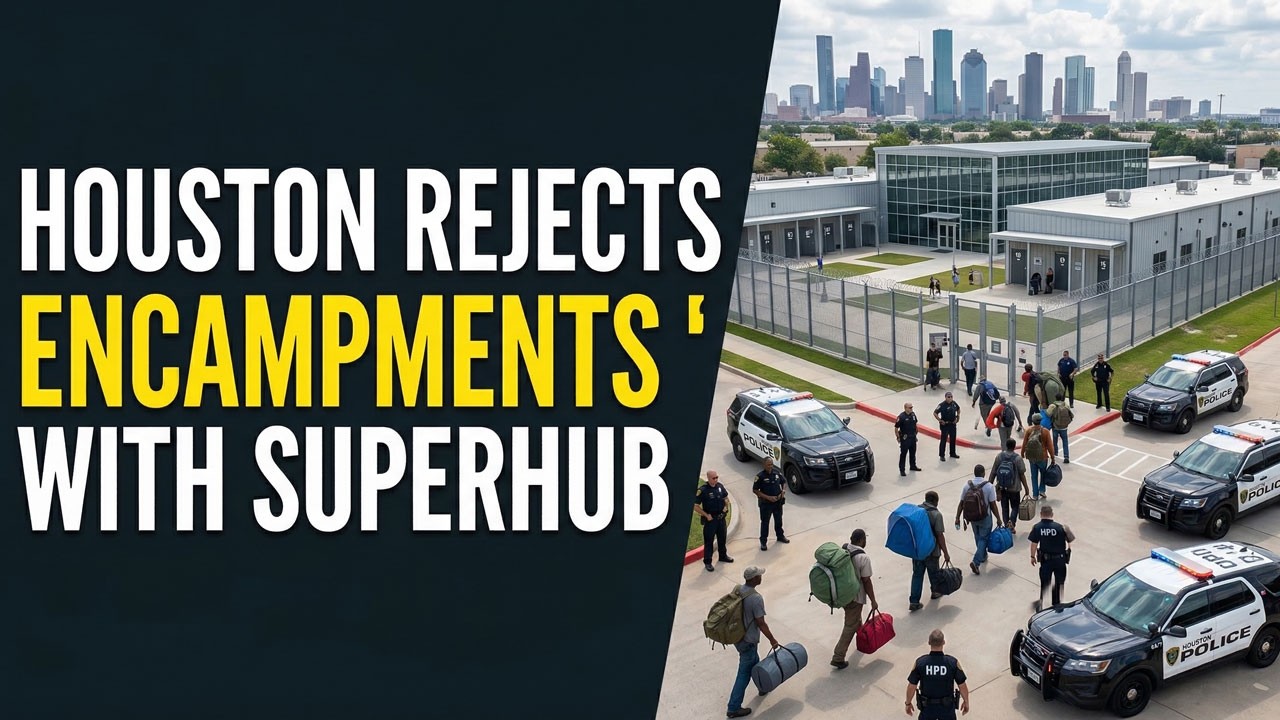
Houston just finalized a federal partnership to stand up a Houston homeless super hub—a 24/7 intake center with a permanent police presence that rejects the Housing First model and aims to clear encampments before the city hosts FIFA World Cup matches.
Key Takeaways
- The Eado facility at 419 Emancipation Avenue offers over 200 beds—up to 220 people—and targets moving at least 1,000 people through its doors per year.
- It carries a permanent 24/7 police presence with Houston officers and a sergeant based inside.
- It’s a converted former migrant children’s shelter; the site’s two lots are valued at $6.7 million with a $16 million purchase price and $10–14 million projected annual operating costs.
- The federal government under the Trump administration has rejected Housing First; the facility is expected fully operational by June 2026.
What is the Houston homeless super hub?
The Houston homeless super hub is a central gateway that scoops people off the streets and routes them to services—health care, psychiatric care, and addiction treatment—rather than simply handing them a room. It’s called a “super hub” not because it houses huge numbers, but because it serves as the central intake point for the city.
Housing First is the policy of placing people directly into permanent housing with no preconditions—and the whole design here is a deliberate pushback on it. The goal, officials say, is to get people stabilized, into jobs, and off the streets.
How is this different from Housing First?
The difference is enforcement and expectations. Housing First, as described here, puts people who are on drugs, mentally ill, or carrying criminal backgrounds into housing and hopes for the best—while they keep using. The Trump administration and the Deputy HUD Secretary who toured the site have rejected that model in favor of upward mobility and results.
That failure pattern is one we’ve documented before in Washington’s Housing First outcomes. The Houston bet is that a hub plus police muscle changes the incentives.
It’s our mission to get the homeless off the streets of Houston, and out of our neighborhoods.
Why does the police presence matter so much?
Because enforcement is what most of these programs lack. The persistent problem with permanent supportive housing is that 911 gets called constantly when people spiral on drugs, and operators too often just let it happen. Here, roughly eight officers and a sergeant are based on-site, which means someone can say “you can’t do that here”—and back it up.
The muscle also handles the harder cases: anyone with outstanding warrants can be routed into the court system rather than back onto the sidewalk. That’s the ingredient missing in the encampment approach seen across Seattle, Portland and Los Angeles, echoing our Seattle homeless policy coverage.
Why now—and why this location?
Timing is everything. The facility is expected to open around the start of June, right before the World Cup arrives at the end of the month, letting the city clear encampments and give those people somewhere to go. The site was chosen because it was already used to house migrant children, comes with a security system and razor wire, and won’t need major renovations.
Not everyone is sold. Former Harris County GOP candidate Bobby Orr argues that with the city hosting World Cup matches, committing $2 billion to convention center redevelopment, and hosting the 2028 Republican National Convention, putting a homeless hub nearby is a step backward. The counterpoint: if the streets around that $2 billion investment get cleaned up, isn’t that the point?
Who runs this and how much does it cost?
Mayor John Whitmire—a Democrat whose priorities center on public safety, infrastructure, fiscal responsibility and homelessness—backed the hub, arguing it improves safety for both residents and clients by centralizing services. The economics look modest by big-city standards: a $16 million purchase, $10–14 million in annual operating costs, part of a broader $168 million plan to move people into permanent housing.
Compare that to Seattle figures cited in the episode, where roughly three-quarters of a million dollars can go into a single tiny home for one person. The Houston numbers, for a 220-bed hub, read as strikingly cheap.
Frequently Asked Questions
How many people can the hub serve?
It has beds for up to 220 people, with a stated goal of moving at least 1,000 people through the facility every year.
Will the hub turn people away?
No—unlike shelters that require referrals or scheduled intake, it won’t turn away anyone seeking assistance, and people can arrive on their own, with law enforcement, or with pets and partners.
When will it be fully operational?
Officials expect the facility to be fully operational by June 2026, timed just ahead of the FIFA World Cup.
Is a police-backed central hub the honest way to handle street homelessness—or just a way to move people around before the cameras arrive for the World Cup? Tell us what you think in the comments.
Related Coverage
- Housing First Policy Failures: How 30,000 Lives Were Lost in Washington State’s Homelessness Crisis
- Portland Homelessness Crisis: $724 Million Spent, 61% Population Increase Proves Housing First Policy Failure
- Canada’s Housing Emergency Declarations: How Homeless Encampments Double Despite Billions in Funding
- Housing First Policy Disaster: Homeless Shelter Violence Leads to Murder Over Spilled Wine in Bellevue
Full Episode Transcript
Read the full transcript of this episode
A major federal partnership was finalized in Houston today to tackle homelessness and power the city during disasters. US Deputy HUD Secretary Andrew Hughes joining Mayor Whitmire for the tour of the new super hub. >> church 2,000 first, second, and third and really getting decent the wrap-around services that they The HUD Secretary says Houston is now the proving ground for a new approach to homelessness. Yeah, good evening Anthony. So, the people that we spoke to tonight in Eado say that they’re not against people getting help in this proposed facility that’s behind me. They just don’t want it here.
>> Now, the goal inside this building is pretty simple. It’s to get people stabilized, get them into jobs, and most importantly, keep them off the streets. This proposal for this 24/7 access facility in Eado would offer up to 200 beds, over 200 beds, and connect people to health care services, to psychiatric care, to addiction services. The city says this is part of a larger plan, a $168 million plan to move people from the streets and into permanent housing. For good. Now, here at 419 Emancipation Avenue, there are beds for up to 220 people with a goal of moving at least 1,000 people through these doors every year.
region crowded into buildings for several town hall meetings. There were concerns about increased crime, traffic, among a list of other worries. But, the Second Ward, the focus is on safety. The mayor has promised a permanent 24/7 police presence here with AHPD officers and a sergeant based inside. But, Mayor John Whitmire and others who supported this idea of the Central Hub said it will actually improve safety for residents and those clients being served to have a central location to get the help they need. >> The hub is also part of a $100 million plan to bring industrial backup power to this site and 100 others across the city, ensuring that even during a hurricane or other crazy Houston weather that these life-saving services never stop.
We are reading from Texas Scorecard, real news for real Texans. All right. Houston announces new $16 million low-barrier homeless super hub. City of Houston spending $16 million to turn a former migrant shelter, migrant shelter for kids, into a homeless super hub. Facility officials say it will streamline access to services, but critics warn it will damage the city’s image ahead of international events. We got the FIFA World Cup coming, not only to Seattle, but to to Houston, Texas, as well. Houston is I think they’ve got seven seven matches. What is Seattle doing? They’re fumbling around with some 500 bed capacity deal.
We’re going to put up 500 more beds. The difference with this bad boy here is that they can they can clear out a bunch of encampments all at once, send these people here, get these people the help that they need, and they’ve got 24/7 police coverage with a sheriff inside the facility. So, the main thing with permanent supportive housing is that 911 is constantly being called because people get out of control because they’re whacked out on drugs. They’re allowed to do drugs, and there’s there’s no barriers of entry. They’re they’re mentally just you know, out there doing drugs, and you just stick them in a room, you know, in a in a like here in Bellevue in a 92-room Plymouth Crossing facility, and then you wonder when they have problems, right?
Cuz they’re doing a bunch of drugs, and yeah, the the city lets them the county lets them do it. Here, it’s it’s a little bit unclear. I I I haven’t found hey or, you know, it’s no barrier coming in, but then do they require people Oh, there’s no drugs in here. And if you’ve got a police presence, then it kind of becomes like prison, right? Or jail, right? Do they Do they do the drugs when people aren’t looking? You know, how’s that work? Don’t really know, but I think this is Houston’s This is This is what everybody always talks about. You just need to get all the homeless in one location and then work it out from there.
And you you Everybody always says, “Well, make it an island.” Well, an island doesn’t have the services that these guys need. Those services are all in this part of town. This is downtown Houston, right? So, it’s already there. You’ve already got homeless people spread across that part of town, and also all throughout Houston. So, they scoop them up, put them here, and then it becomes a hub for sending them out to psychiatric care, uh detox, you know, treatment, whatever that might be. Or if you’ve got police there and these folks have outstanding warrants, off they go to jail, you know, go to the court system, whatever it is.
But, this is one of those things, whether or not it works, it’s a deal where Houston is pushing back in large fashion. And you would think, “Well, that’s a Republican state for you.” Yes. Yes, it is. However, leadership in most big cities is run by Democrats. And this This mayor is not. Uh he is he is a Democrat, but he ran John Whitmire Key Priorities as Houston Mayor center on public safety. Huh, weird. All right. Yeah, more cops. Infrastructure improvements. All right. Holding the city together. Fiscal responsibility. Good lord. And then addressing homelessness, because he knows you got to square away the homeless, otherwise people don’t want to run businesses there.
So, I mean this guy’s this guy’s he’s a Republican, right? Any other in in in any other in a in a blue state like where I am, Washington or Oregon or California, this guy’s a Republican. He’s a moderate Democrat. But in in Houston, in Texas, yeah, things are things are, you know, a little bit further right. So, so this guy running on this, man, if we had that in Seattle, nobody’d elect an official like that. Oh, more police? No. Addressing homelessness? No. Instead, they run on these stupid affordability things that they can’t do anything about. So, I thought what was interesting is they they picked this because it’s already been used for similar purposes.
It’s already been used to house, I think it was um immigrants, children. I think that’s what it was. It’s equipped with a security system and won’t require major renovations. It’s already up and running. It’s already got the razor wire. Just put a handful of cops, I think it’s going to be like eight cops and a and a sheriff. I mean, that’s one of the huge things that I see is there’s not enough police oversight, and the people that typically run these things just kind of let it just let it, you know, they get on their back and they just let it happen. Just ah greatest thing ever. And then you’ve got men being raped in the bushes, right?
And I’ve literally talked about that here in Bellevue. It’s being described as a super hub, not because it’ll house large number of people or offer extensive site programs, because it will serve as a central gateway. Round them all up, get them off the streets. And if people are already in community parks, lining the streets, lining the sidewalks, you know, I think this could work from the standpoint of well, you’re getting them off of there. It’s just a matter of when they come to one of these places, are they being taken here? Don’t really know. I know they can go here voluntarily, but will they?
If they get swept from their encampment, and they get taken here, they don’t have a lot of options. But what this does, ultimately what this does, is this is a pushback on hey, we’re just going to let homeless people live wherever. It’s a pushback on that. That is what Seattle doesn’t do well. That is what LA does not do well. It’s what Portland absolutely fails at. San Francisco is turning that corner. Turning that corner because they are involving law enforcement. And to me, that’s one of the crucial elements of this. You got to have somebody in control who can drop the dime, right? Hey, you can’t do that here.
And it’s a cop. All right, guy’s already on parole, right? Uh so, you’ve got to have enforcement. You’ve got to have muscle. The goal official said is to make intake smoother and movement between services faster for those seeking help. What about for those not seeking help? What about And that’s that’s always my concern is you got a bunch of drug addicts running around who don’t want help, who just want to live in their encampment. Well, this pushes back on the the the theory hey, you can live wherever you want. It’s all good. It’s all good. If they get moved enough times and they get, you know, police direct them here, there, wherever, maybe they have to get sober.
You know, but when you start looking at that, because this is an alternative, this is being being billed as not housing first. Meaning, you don’t just put them in the permanent supportive housing and hope for the best, cuz they’ll continue doing their drugs and kill themselves. So, that model is out. First housing we know does not work. Cuz it it doesn’t require anybody to actually change their life for the better. It just gives them a roof roof over their head, and then we hope for the best. Ah, this should work out. Right? Unlike other shelters that require referrals, law enforcement drop-offs, or scheduled intake times, the center will not turn away anyone who shows up seeking assistance.
And from that standpoint, okay, so you got just a whole bunch of homeless people walking through the neighborhood. That’s not going to be good. Okay. But if you have law enforcement there, then all right, is you know, cop going to get in his car and drive a block away to help with somebody just having an absolute breakdown? Don’t know. People will be allowed to walk in, arrive with law enforcement, or come with pets or partners. And the hub will coordinate closely with surrounding agencies to get them where they need to go. Well, that’s what’s always been sold at any of these various types of facilities.
We’re going to really work with the clientele. These clientele need to be told what to do. They’re whacked out of their mind on drugs. They’re stealing from the community to get said drugs. They are mentally unstable most of the time. And you know, they’ve been living basically off-grid, but in the city, you know, in a tent and just getting handouts and So, um I thought it was interesting that the two lots that make up the site are valued at 6.7 million. Um you got Uh and you got a purchase price of 16 million. Annual operating costs are projected between 10 and 14 million. That seems cheap. That seems really cheap compared to what all the numbers I hear on just absolutely hideous Seattle numbers, you know, where people are spending 3/4 of a million dollars on one dude getting into one tiny home.
It’s just it’s insane. So, here here’s a here’s a con. Orr argued, uh this is Bobby Orr, former Harris County GOP candidate. Orr argued that the city’s on the verge of hosting FIFA World Cup 2026 matches, has recently committed 2 billion towards the convention center redevelopment, and will host the Republican National Convention in 2028, making the decision to place a homeless hub nearby, in his view, a major step backward. All right, but if you are clearing out the encampments, and you are pushing people here, your streets are cleaner, right? I mean, this is the end goal, your streets are cleaner.
Isn’t that what you want? You want the streets of Houston cleaned up, and you need a hub like this to make that happen, and you need law enforcement to provide the muscle. To to provide the hey, you can’t do this, let’s work on doing this. That is the wrong location for this city, it’s undermining a $2 billion investment. Yeah, but if you’re making a $2 billion investment, don’t you want it to be in an area that’s been cleaned up? Maybe this is how you do it. I’m just spitballing here, right? All right, take a look at another one. We have the US Deputy HUD Secretary. That’s uh that’s this dude here.
He came out to take a peek at it, because the federal government, under the Trump administration, they have rejected Housing First. Because we all know Housing First is just a massive massive failure. You’re taking people whacked out on drugs that are mentally ill, that a lot of them have criminal backgrounds, and just pushing them into housing, and hoping for the best. Because the people like, ah, do you want do you want treatment? No. Well, what do you want? Ah, I just want to keep doing my drugs, and and you guys pay for everything. Okay. That’s what big blue cities do, right? Okay. They just take it.
Here’s the neighbor, we’re goal-oriented, and it’s our mission to get the homeless off the streets of Houston, and out of our neighborhoods. See, big difference there between Republican-run states and Democrat run states. You have a a neighbor uh talk about that. Here in Seattle would be there are neighbors and we don’t want to disrupt their lifestyle even though they’re doing drugs, having a bunch of crazy sex, taking the condoms through flinging them in the street, leaving human excrement behind, needles, tin foil, doing the doing the drugs, um human trafficking, sex trafficking on the sidewalk in front of the homes.
And the people in the homes are saying, “Don’t disrupt our neighbors.” It’s mentally It’s mentally just And that’s why Portland and Seattle get what they get, which is just overrun with homelessness. And then you elect a you know, a socialist mayor and you wonder why things aren’t ever going to get any better. Huh. She runs on an affordability platform where she can do zero for affordability. So, the facility represents a significant policy shift by the Trump administration away from traditional housing first models. He has emphasized that the federal government is looking for upward mobility and results.
Get them off the streets, get them into programs, get them some help. And you know what? The the the the the the backdrop to all this is that if the homeless folks realize Houston has a program that actually pushes them into the scenario and they don’t want to be part of that, I’m sure Houston can figure out a way to get them to Portland, get them to LA, get them to Seattle, right? Not San Fran cuz San Fran’s dropping the hammer as well. So, you’re going to have cities or you know, maybe maybe maybe they push them to San Antonio. I don’t know, you know? Um Actually, I think San Antonio has some pretty aggressive homeless stuff as well.
Dallas, I know has worked hard at cleaning out their downtown core. Um but when you have a population of, you know, 12 or 15 million, whatever DFW is, is um you’re going to have some homeless folks. So, this is Houston’s got a lot. Houston’s got They’ve got their hands full. This facility is going to open up. It’s supposed to be beginning of June, which is perfect because the World Cup happens end of June. So, they can just go ahead and just clear some encampments, have a place to put these folks, and I think that’s the end goal. It is basically, let’s get this bad boy cleaned up before before the World Cup comes.
You know? And then, uh if it works out, great. It sounds like it’s a long-term solution. We shall see, right? Cuz, you know, most of these things have failed. Most of these things just kind of come and go. And um you know, neighbors get all worked up, “Not in my backyard.” Nobody wants this in their backyard. But it’s got to go somewhere. And you can’t put it way out on an island in the ocean because there’s no services there. So, you have to basically do a full-fledged island, which is super expensive. You’ve already got the facilities in the downtown core, and that’s why the homeless always gravitate towards the downtown, because further out in the rural areas, there’s no homeless support.
There’s no handouts. There’s no gimmies. The drugs aren’t there. Right? So, you got to go to where all that stuff is. And you can’t steal from people in the rural communities cuz they’ll shoot you. Especially in Texas. They’ll shoot you. Hey, you’re breaking into my house. And And that’s how it goes, right? The funding controversy. So, you got a bunch of money, you got federal money, you got private money. We’ll see how that goes. Facilities expected to be fully operational by June 2026. Crazy that the World Cup is during that time, right? That’s I mean, yeah. This is not This is not rocket science.
This is cities reacting to having the the spotlight on them, and it’s interesting to see how each city kind of comes up with a different approach. But, Houston, I I this this could work from the standpoint of you clean up the streets, you don’t allow them to go back on the streets, you sweep you sweep you sweep. And then you’ve got a program, you’ve got a plan, you’ve got a hub to disperse those people to wherever they need, and it’s also got a climate-controlled um animal center. So, you can bring your pets. I think I think you can bring your dogs and cats. I know you can bring your dogs. Uh the climate-controlled kennel, so dogs, right?
Yeah, I mean, I I I get it. Homeless people they they have dogs, they have pets, it makes them feel good about it, but are those the people that should actually be responsible for, you know, another life? Granted, it’s an animal. Whole thing Whole thing’s just How do we let this happen to this extent? Wild. All right. We’ll be covering this more when this opens up, we’ll do a podcast on that. Make sure you subscribe, hit that notification bell. I’ll see you in the next episode. Thanks again for joining. Bye for now. >> [music]


