
Watch the full episode in the player above — everything in this article comes straight from the episode.
Prefer audio? Listen to the podcast version:
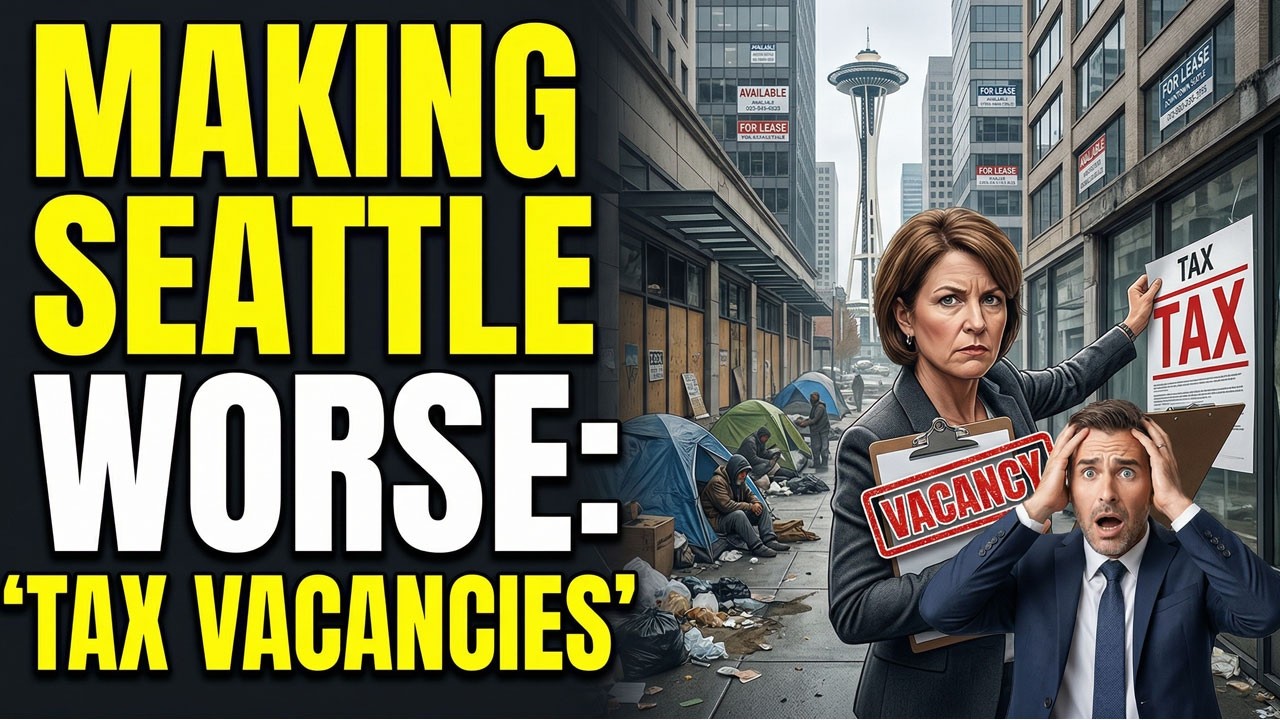
Seattle has one of the worst office vacancy rates in the country, and mayor-elect Katie Wilson’s answer is a Seattle vacant office tax—penalizing landlords for empty space rather than cutting taxes, clearing the streets, or giving businesses a reason to come back.
Key Takeaways
- Seattle’s office vacancy rate hit around 27% and was, at one point in October, the highest in the nation; some downtown reports put it near 35%, with Pioneer Square over 50% in places.
- Wilson ran on “progressive revenue” and proposes taxing owners of vacant office space.
- Amazon has shed more than 1 million square feet of Seattle office space since 2020, including nearly 595,000 square feet since 2024.
- Downtown building values have fallen roughly 50%, shifting the tax burden toward residents.
What is the Seattle vacant office tax?
The Seattle vacant office tax is a proposal to tax commercial landlords for keeping office space empty, on the theory that taxation will force them to fill it. It treats vacancy as a landlord choice rather than a symptom of the city’s business climate.
But a downtown-core landlord can’t control the external factors driving tenants away. As the episode puts it, you can fix up a bad rental house—but you can’t fix the neighborhood around a downtown tower by yourself.
Why is Seattle’s office vacancy so high?
Because businesses have fled a toxic climate—sky-high crime, open-air drug markets, and sidewalks lined with the homeless—on top of some of the highest business taxes in the country, including a payroll tax. Companies aren’t leaving offices empty out of spite; they’re victims of conditions that make CEOs reluctant to renew leases or bring workers back.
Amazon is the clearest example, shedding more than a million square feet since 2020 and moving thousands of employees to Bellevue. This is the same exodus we tracked as vacancy hit 27.2% and again in the record 39% doom-loop report.
Charging owners for vacancy is like fining a farmer for a drought.
Will taxing empty offices actually fill them?
No—and that’s the core objection. The Washington Policy Center analysis cited in the episode calls it using “the hammer of taxation to force economic behavior rather than addressing root causes.” Fining a landlord doesn’t make a tenant materialize any more than fining a farmer makes rain fall.
Landlords already carry very high taxes, mortgages, maintenance, and the cost of repairing crime damage. Piling on a vacancy tax risks accelerating capital flight as owners sell off buildings or pass costs to remaining tenants—hollowing out the economy further.
What should Seattle do instead?
The alternative is to lower barriers, not raise them: tax cuts, streamlined permitting, and aggressive public safety reform. Texas and Florida succeeded by lowering barriers; Seattle’s progressive revenue grabs have already chased away major employers, a pattern reinforced by the looming Washington millionaire tax and tech layoffs.
Wilson has also signaled a return to less drug enforcement, which the analysis warns would reverse the modest progress cities like San Francisco made by involving law enforcement. Doubling down on extraction while backing off enforcement points the city the wrong way.
Who is Katie Wilson and what did she run on?
Wilson is Seattle’s incoming mayor, described here as an inexperienced pick in the mold of New York’s socialist turn. She previously attacked Kroger for closing a Lake City QFC, blaming corporate greed, and vowed a progressive tax agenda and “progressive revenue” to fund city services.
Her platform—results on homelessness, affordable and abundant housing, public safety, and “Trump-proof Seattle”—runs headlong into the same tax-and-regulate approach that constricted housing supply and drove costs up in the first place.
Frequently Asked Questions
How bad is Seattle’s office vacancy rate?
It reached around 27% and was briefly the highest in the nation, with some downtown reports near 35% and Pioneer Square above 50% in places.
How much office space has Amazon dropped?
Amazon has shed more than 1 million square feet of Seattle office space since 2020, including nearly 595,000 square feet since 2024.
Who ends up paying when building values fall?
With downtown values down roughly 50%, the lost commercial revenue shifts onto residents through their residential taxes.
If crime and taxes emptied Seattle’s offices, can taxing the empty offices possibly bring tenants back—or does it just push landlords to walk away? Share your take in the comments.
Related Coverage
- Seattle Socialist Mayor Katie Wilson’s Tax Plans Will Devastate Homeowners and Businesses
- Denver Office Building Values Crash 90%: How Progressive Policies Created a Commercial Real Estate Apocalypse
- Downtown Seattle Office Crisis: Martin Celig’s Strategic Defaults Signal Commercial Real Estate Turbulence
- Seattle Elects Socialist Mayor Katie Wilson: Why This Spells Economic Disaster for America’s Most Expensive City
Full Episode Transcript
Read the full transcript of this episode
More Seattle restaurants are closing and office vacancy continues to go up. These are some of the challenges facing Seattle’s new mayor-elect. >> Years after the pandemic, there’s still plenty of empty office spaces in Seattle and the problem is only getting worse. We now have the second highest office vacancy rate among major US markets. In October, Seattle’s office vacancy rate was the highest in the entire nation, reaching around 27%. >> Another shakeup at Amazon as the company closes down one of its Seattle locations and moves hundreds of workers to other facilities around the region.
Downtown Seattle, even quieter. Some reports put vacancy near 35%. Pioneer Square, over 50% in places. If you walk through downtown lately, you felt it. >> Empty storefronts and locked-up restaurants, you’ve probably noticed it yourself while walking around downtown Seattle. New reports show downtown’s office vacancy rate is nearly the highest in the entire country. >> Seattle’s socialist mayor has a solution. A solution. This city’s empty offices. Guess what it is. Now, you might think, “Hey, reduce taxes. Hey, provide some incentives for businesses to come and lease out that space.
Maybe clean up the streets. Get rid of the drug dealers. Get rid of the open-air drug markets. Maybe get rid of the homeless people lining the streets.” Do some of that, but no. That’s not what it is. It’s tax the owners of the vacant office space. Ah, there it is. Progressive revenue. Progressive revenue and further punish those commercial office landlords for their dastardly deeds of keeping this space vacant. Because we know that they can just shuffle some tenants in there. We know that all these commercial markets across the United States can just, you know, plunk some businesses in there and get going.
They just don’t want to. They’re just lazy, right? No. But, this goes way deeper than that. And that’s where That’s where some of this ideology, this socialist just nonsense, it comes out. You know, like, “Ah, let’s tax the landlords. We’ll make them get tenants.” How are you going to do that? If you got a bad Think of it, if you got a bad bad rental property and nobody wants to rent it, what can you do to get people to rent it? You can make the house better. But when you’re in a location like a downtown core like Seattle, that’s an external factor that you can’t do much about. And when businesses are leaving Seattle and coming to Bellevue, going anywhere, going to Utah, was um Washington State food company just said, “Hey, we’re shutting down in Kent, Washington, and we’re leaving.” And that’s a statewide deal.
And Seattle is certainly part of the state. Let’s get into these articles. I mean, this is just This is one of so many storylines that have come out that you’re like, “What?” That makes no sense at all. It’s why we’re reading it. Seattle decided to follow in New York’s footsteps and elect an unqualified, inexperienced socialist as its next mayor. Katie Wilson’s in her 40s and spent most of her life being bankrolled by her wealthy parents. Back in August, Wilson attacked Kroger because Kroger closed down a QFC in Lake City in Seattle. Tough area. Tough area in Seattle. Uh she attacked Kroger for closing stores in Washington, citing crime and the cost of doing business in the blue state.
Kroger closed down a bunch. And they said, “No, we’re not doing business here. You got high taxes, you got a safety factor, and you’ve got shoplifting that’s just off the hook. These are We We can’t make a go of it here. So, adios.” We covered that here. Wilson blamed corporate greed for the move and vowed to align with unions to ensure all neighborhoods in our city have access to healthy food and medicine. How you going to do that? You can do city-run grocery stores? Good luck with that. Imagine that in Seattle. Imagine that in in any of the failing neighborhoods of Seattle. State-run, city-run grocery stores.
What a terrible idea. Those places would go out of business like that. But, they’re funded by Seattle taxpayers, so Seattle might do it. And Mum Danni, he did the same thing. He’s going after this progressive revenue in New York City because everybody’s moving to Florida. Governor Hochul is basically stating, “We sure like some of those billionaires and millionaires to come back from from Florida to to to fill our tax coffers back up cuz that ain’t working.” This is the same drill. Where can we tax Seattle businesses? Where can we tax Seattle wealthy folks? How do we make this go? What do we do?
After winning her election, Wilson vowed to enact a progressive tax agenda. I love the I love the progressive in there, right? It just You might as well just You might as well uh substitute that with stupid or ineffective or never going to work or totally bad idea. You can you know put that in there for any one of those, right? Like totally bad idea tax agenda. That works. and collectivism in her city. Telling the media, “I’m very committed to make sure we use our existing resources as effectively and efficiently as possible.” So, the landlords who can’t save their their office space any which way from remaining vacant cuz nobody wants to be in Seattle.
You have a massive tax problem. You’ve got some of the highest taxes in the country in Seattle on businesses. You’ve got a payroll tax. Tax Amazon, right? Amazon just moves thousands of people from Seattle to Bellevue and the numbers are just so so apparent. It’s like Seattle loses 12,000 people or something like that or Bellevue gains 12,000 people and Seattle loses employees. I do think we will pursue new progressive revenue, she added, in order to fund our priorities and make sure that we’re delivering services to the people of Seattle. I mean, it’s it’s almost like the same nonsense that Kathy Hochul says in New York.
We need the wealthy people to come back so we can pay for all the welfare programs that are fabulous. You’re like, no, cut those. Cut those and cut all your taxes and redo your state because you are going down the tubes. There are several progressive tax options I proposed as part of my platform. We’re going to have city staff looking into developing those legislation. So, the tax vacant storefronts is is one of those just Okay, so you’re kicking somebody when they’re down. That’s what you’re saying and it’s because of terrible Seattle policies that this is happening. And you the way that you were able to figure that out is there’s other cities that aren’t facing the same vacancy factors, that don’t have the high taxation.
How about all of Texas, all of Florida, right? North Carolina, South Carolina, Arizona, Utah, Nevada. Generally low tax states. They’re going there. Businesses are going there. And it appears she’s keeping that first promise. Seattle is the second the nation’s second worst office vacancy rate, maybe the first. It’s it’s neck and neck, right? This is much like Kroger. Due to crime and the cost of doing business in the city, we’re also sure the left’s insane COVID policies had a role to play, too. To solve this problem, Wilson is going to tax the owners of those vacant offices. It’s just Here here Here it is, Future 42.
Is Seattle new um Mayor Katie Wilson’s solution to attract business back to downtown? A, lower taxes for businesses. B, clean up drugs and despair off the streets. C, tax owners of vacant office buildings. Ugh, that’s classic. Classic, love that. Cuz it’s just so terrible. It’s it’s so awful. You know what I mean? According to Seattle Morning News host Charlie Harcur, yeah, he um he just basically called it what it is. Open-air drug markets, people strung out on the sidewalks. I I mean, businesses don’t want to have their employees around that. You got people chasing each other around with machetes.
Um and the downtown core is particularly bad badly impacted by this this policy. It has gotten better. But this is going to take a long time because you’ve got tax policy and you’ve got fact future tax policy like the Washington state millionaire tax. Well, whenever you raise taxes, people tend to flee for cheaper pastures. That’s how it’s always been and how it will remain. Yet socialists like Wilson don’t seem to operate in or understand economic realities. So, they’ll continue to do the wrong and take our money. Let’s look at another one. Here we go. This is uh Paul Washington Policy Center.
Penalizing property owners for Seattle’s poor financial decisions. Let’s get down to At its core, this vacancy tax embodies the worst instincts of progressive governance using the hammer of taxation to force economic behavior rather than addressing root causes. How are you going to force these people but when you’re hitting them again when they’re down? How are you going to force these people to get tenants in there? That’s kind of backwards and I don’t mean kind of. It’s totally backwards. This is wonky ideology that will never work. Like socialism. Oh, wait a minute. Wait a minute. Socialism works for those who don’t, right?
Socialism works for those who don’t. Terrible. Terrible. Property owners aren’t leaving offices out empty out of spite. There’s this notion by the left that these owner these property owners are just so wealthy that they can, you know, just afford to have their their space empty and for some reason they’re just being lazy about getting new tenants in there. Like they have taxes to pay. Very high taxes. They’ve got mortgages to pay. They’ve got maintenance to pay. They’ve got broken doors and windows and shops to fix because your terrible policy on crime in Seattle makes them a target day in and day out.
They are victims of Seattle’s toxic business climate. Sky-high crime rates, open-air drug markets, and sidewalks littered with the homeless have driven companies away. And it’s going to take years, years to get them to come back because why would they come back to Seattle? Why would they come back to Washington state? They wouldn’t. Making CEOs reluctant to renew leases or bring workers back to downtown. Same thing in Portland. Same thing in San Fran. Fran San Fran’s got a an AI kind of revolution going on though. And San Fran has worked very hard to clean up its financial district. Basically just corral all those people under the Tenderloin.
And you’ve got you know, Daniel Lurie, the mayor, duking it out, his his bodyguard duking it out with the homeless in the Tenderloin. And that’s not going well. While the city has seen a positive change in the reduction in property and violent crimes, Wilson has indicated the policy of the city will return to less drug enforcement, which will reverse the trend. Doesn’t want to arrest people doing drugs out in the open. Doesn’t doesn’t want to arrest them. And And you know what you know what the comment that always gets me is, “Why don’t we just toss the drug dealers in jail?” It’s a really good question, isn’t it?
It’s a really good question. Here’s the answer. Because if they did, that never-ending cycle of drug addiction would get really rocked. And what would those people do? They They’d do some crazy stuff. They would go out of their minds. You cut off You cut off the drug supply to Seattle’s massive drug-addicted population, you’re It’s It’s going to be pure anarchy. That’s going to be pure the pure the purge. You You’re going to have just some crazy stuff going on. So, you can’t really you you can’t If If you want to keep all these homeless people in Seattle, which Seattle does, and every other major big libtard city does, because they get funding for it, right?
They get federal funding for it. So, there is zero incentive to reduce homelessness. It’s just not a thing. And so, if you keep them there with drugs, got to keep the drug dealers in. Plus, we’ve got this whole more idiotic policy called justice reform. That just means letting the criminals out of jail. Just let them out of prison. They’re all good. I’m sure they’re they’re reformed. They’re all good. Let them back out on the streets. And that’s how you have, you know, the felons with 25 30 convictions just out running around the streets, just roaming around, doing their thing cuz they know nobody cares and the justice system isn’t going to have any consequences for their actions.
While the city has seen positive change, yep, imagine owning a commercial building in a neighborhood where potential tenants fear for their employees safety. Most of downtown. Except for like South Lake Union cuz um Yeah, Amazon Amazon has their own crew of security there and Amazon is specifically moving out of like the Denny Triangle area, which is further to the west from the South Lake Union area. You can’t attract renters because of rampant theft, vandalism, public disorder issues the city has failed to curb significantly. Instead of incentivizing revival through tax cuts, streamline permitting, or aggressive public safety reforms, the mayor’s plan doubles down on extraction.
Money from business owners. Charging owners for vacancy is like finding a farmer for a drought. That’s a good one. Hey, you’re not growing anything. Going to fine you. Doesn’t make rain fall, but it sure makes farming harder and this would make commercial landlording harder. But you know what? Socialists don’t care cuz they don’t want any landlords. They want everybody to own everything and nothing all at the same time and we’ll all be happy with it. Does that sound like just Shangri-La? Does that just sound epic? This approach risks accelerating capital flight as owners sell off properties or pass costs to remaining tenants, further hollowing out the economy.
And here’s here’s Charlie Harger again, rightly decry this is a knee-jerk socialist fix that ignores economic realities. And here’s where they’re going. Texas, Florida succeeded by lowering barriers. Seattle’s progressive rev- revenue grabs already chased away major employers. And that is what’s going on on the daily, right? Here’s some of that backdrop. Downtown Seattle office values plummet. Raising concerns among city leaders. We have concerns. Most of the buildings in Seattle have fallen by about 50% cuz you’ve got some of the highest vacancy factor in the United States, specifically in the business core.
And across Seattle, we’re we’re still top five in the in the nation. You know, we’re we’re we’re neck and neck with like San Francisco. Ugh. So, you got office values plummeting. So, all the taxes and all the businesses that should be in Seattle that aren’t, that’s causing value of the buildings to fall. You got to assess values that no longer kick off that revenue stream. Who’s going to have to make that up? Residents of Seattle with their residential taxes cuz people still need a home to live in, right? Amazon has shed more than 1 million square feet of office space in Seattle since 2020. But let’s go ahead and tax the commercial real estate market because those rich rich bastards, we got to make them pay.
They have to pay. They have to pay their fair share. You know what I mean? It’s it’s just it’s it’s it’s mind-blowing that this is the solution proposed. Hey, we’re going to tax that vacant storefront. So, in in May, tech giant will vacate the 251,000 square foot building on Terry Avenue. It’s one of many many buildings that Amazon has said, “Yeah, I don’t think we’re going to renew that lease.” Amazon has shed nearly 595,000 square feet of office space within Seattle since 2024. We’ve got what, close to 20 million square feet of office space, some some enormous number like that in Seattle on the market, just vacant.
It It’s nuts. Here is Here is Katie Wilson’s Harrell Pledge. Harrell Pledge, “The city must raise new progressive revenue to continue to continue to deliver the services residents depend on, from libraries and parks to shelter and public safety.” Okay, but it’s the businesses that create the revenue in the form of taxes. You’re going around this You’re going about this just absolutely ass backwards, right? Just You’re doing what for what? That makes no sense at all. It’s okay. We’ll just We’ll just double down and just We’ll just go ahead and do it. It’s all good. So, I I get it. I I understand the the voters in Seattle.
They’re They’re liberal leaning. They’re left leaning. And they don’t understand the cause and effect when you tax a business for a vacant storefront. You know, it’s more likely that they’ll go under because you’re just adding more fiscal responsibility to that equation on the wrong side than giving them a tax break, than giving businesses an incentive to come into Seattle. But if you look at And And so, when you’ve got a whole bunch of young kids who think, “You know what would be great is if we just had everything cheaper in here.” And then you’ve got a mayor who comes along on Get results on homelessness.
This is her platform. We’re talking about Katie Wilson’s platform. So, taxing the office space is not out of line with any of this. Affordable and abundant housing. Well, Now, go back to her Get results on homelessness. Um she’s looking at homelessness going, “Okay, I don’t really want to sweep them cuz that doesn’t seem effective, but you know, we got to sweep them cuz otherwise the whole thing just comes off the the the rail. And hey, let’s build 500 housing units before the FIFA World Cup comes cuz the whole world’s going to be looking at us and we got to get some of those pesky homeless people off the streets.
We got to get them into shelter.” Those people don’t want to go into shelter and a lot of them already have housing. They just like to do their drugs in their tent encampments. Period. Full stop. How are you going to stop that? Oh, we’re just going to sweep. Okay, affordable and abundant housing. Affordable? No. Abundant? Absolutely not. You’re not going to ever have any in Seattle. It’s not going to happen. You’ve constricted the supply. You’ve layered on all kinds of nonsense. You’ve made the minimum lot cost astronomically expensive with all of your you know, all these regulations, all this climate nonsense.
You’ve loaded it up. You’re never going to have affordable and abundant housing. We’re going to Trump proof Seattle. What does that even mean? You what what are you talking about? It’s just nonsense. Transportation and mobility. Okay, you mean like the homeless people coming to Bellevue on the new light rail? Oh, okay. All right. Public safety. Okay. All right. Yeah. If public safety were a thing in downtown Seattle, you’d have more businesses there. Just You would. You would. A city for working families. Okay, that’s never going to happen. Seattle is too expensive as are most big blue Democrat run cities.
Too expensive. Never going to happen. Because you’d have to take off all the layers and layers and layers of policy and just absolute regulations and nonsense to make it cheaper. Like Florida has already done cuz they never put that in there because they’re run by Republicans like Texas has done. They’re They’re looking at lowering taxes, not adding taxes to landlords that are already down in on on uh their ability. Climate action and environmental justice. Oh, who cares? That’s just not a thing. It’s It’s not a thing. It It just Yeah, it’s just virtue signaling. It’s just It’s just nonsense. Economic development and vibrant neighborhoods.
Good luck. If you got policy like taxing landlords that have vacant space, you’re not going to have any economic development or vibrant neighborhoods because they’re going to continually go down. Progressive revenue. There we go. There’s the final nail in the coffin. So, every single one of her policies that she ran on are not attainable or just virtue signaling or pie in the sky or just stupid like Trump-proof Seattle. Trump-proof Seattle. Huh? Why? We didn’t Biden-proof Seattle when he was in office, right? We just made fun of him cuz he had stupid policies like the the the southern border being wide open.
And then his numbskull Karine Jean-Pierre up there saying, “Oh, border secure.” And 302,000 people come through. Criminal illegals cross the border December of 2023. Oh, the border’s closed. So, you know, a whole bunch of stuff that just doesn’t make any sense and particularly from an economic standpoint, kicking those who are already down that are trying to hold things together despite everything Seattle’s leadership, including progressive revenue, throws at them. I mean, at what point in time do people just basically give up their space and say, “Good luck with that.” Good luck with that. It’s already declined 58% in value, something like that.
So So, then who are you going to tax? The lender? It’s It’s It’s a bunch of people who have no concept of business or economics or reality that we’ve got in Seattle, that we’ve got in New York City. But, I mean, you got to come up with a way to to to feel good about this, and the way I do that is podcasts for days, weeks, months, years, decades. Who knows, right? Cuz this stuff isn’t going to get turned around anytime soon. Make sure you’re subscribed, hit that notification bell. Thanks again for joining. I’ll see you in the next one. Bye for now.


